06 The Quiet Room Method: How Stillness Helps You Understand Your Life
This longform guide expands on my Substack essay, “Understanding Life While Sitting in a Quiet Room.”
To read the original personal piece, visit the link here → https://sagardas5692.substack.com/p/understanding-life-while-sitting
Most people think they need more information, more productivity tools, or more motivation to understand their lives. But understanding rarely comes from doing more. It comes from sitting still long enough for the truth to surface.
In an age of constant stimulation, the simple act of sitting alone in a quiet room has become one of the most powerful psychological tools we have—and also one of the most underused. Modern life encourages speed, noise, and endless input. But the brain doesn’t find clarity at high volume. It finds clarity in silence.
We live in a world where infinite scrolling, algorithmic distraction, constant notifications, the pressure to be productive, the glorification of busyness designed to prevent reflection. Most people are not living their own lives. They are living in reaction to everything coming at them.
Stillness is now a countercultural act. It is how you reclaim your attention, your identity, and your days.
This article suggests The Quiet Room Method—a structured, research-backed approach to reflective thinking. It’s a method for anyone who wants:
more self-awareness
better decision-making
less anxiety
deeper creativity
and a clearer sense of direction
This is not philosophy for philosophy’s sake. It is practical self-examination supported by psychology, neuroscience, and the oldest wisdom on attention.
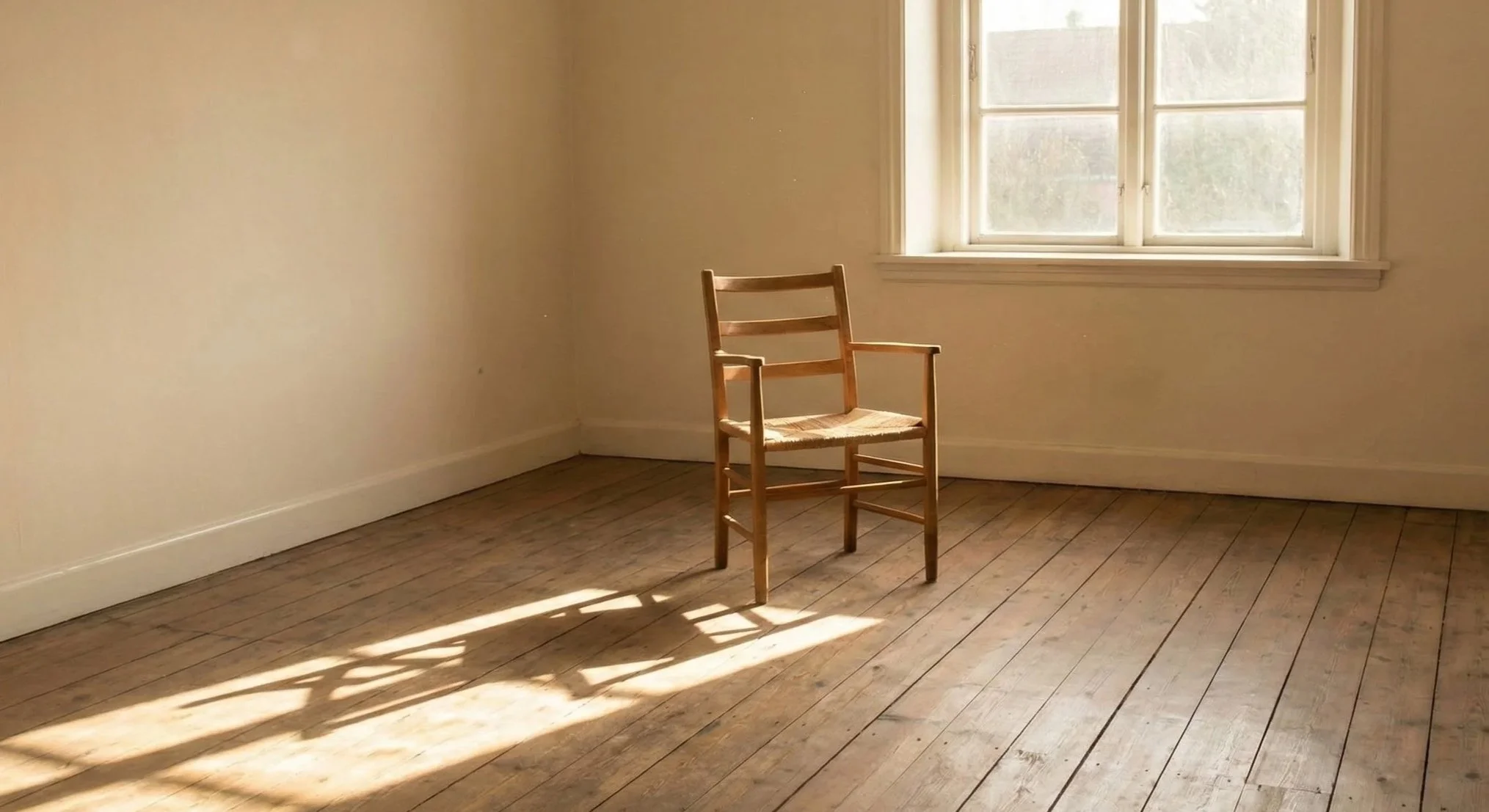
Chair in an empty room
Why Stillness Is So Hard (and So Necessary)
You would think that sitting quietly with your thoughts would be effortless. Yet research shows the opposite.
People avoid quiet even when it costs them.
A 2014 study from the University of Virginia found that many participants preferred electric shocks over being alone with their thoughts for 15 minutes.¹
Why?
Because quiet removes distraction—and without distraction, our inner life becomes audible. We come face to face with uncertainty, unresolved emotions, and the kind of questions that don’t have easy answers.
But the discomfort is also where growth begins.
Silence activates deeper cognitive processing.
Neuroscientists at the University of Oregon found that quiet, internally focused states activate networks in the brain associated with:
long-term planning
emotional regulation
autobiographical memory
meaning-making
In other words: Quiet gives the brain space to understand your life—not just react to it.
Stillness is a reset button for the mind.
When you remove external stimuli, the prefrontal cortex becomes more efficient. Your thinking becomes cleaner. You access insights that are usually drowned out by noise.
This is why deep reflection rarely happens in the middle of a busy day.
It happens in the shower, on a late-night walk, or sitting alone in a dim room when the rest of the world is quiet.
The Quiet Room Method simply makes that process intentional.
What Happens to Your Mind When You Sit Alone
When you sit in a quiet room without your phone, three psychological shifts tend to occur:
A. You break the “input loop”
Most people live in an endless cycle:
scroll → react → scroll → react
This loop prevents deep cognition. The brain is stuck in fast, shallow processing rather than slow, reflective thinking.
Quiet dismantles that loop.
B. Your real thoughts finally appear
When constant input stops, suppressed thoughts emerge:
Why am I avoiding this decision?
Is the life I'm living the life I want?
What do I actually want?
These aren’t comfortable questions.
But they are honest ones.
C. Your identity becomes clearer
According to self-determination theory, personal clarity comes from autonomy and self-connection—not external validation.²
Quiet rooms remove the external pressures long enough for you to hear your own preferences, goals, and needs.
This is why reflection is one of the most powerful forms of self-therapy.
Silence in the Eastern Traditions: What Hinduism and Buddhism Already Understood
Long before psychology began studying the benefits of quiet reflection, the Hindu and Buddhist traditions shaped entire philosophies around the power of sitting alone with one’s mind. In Hindu thought, dhyāna—the practice of focused stillness—was considered a gateway to insight. Ancient texts describe the mind as a restless lake. Only when the surface settles can you see the bottom clearly. Modern cognitive science says something remarkably similar: when our sensory input drops, the brain enters what researchers call a default mode of introspection, which helps us process emotional material, solve problems, and form a clearer self-concept.
Buddhism built its entire psychological architecture on this idea. Meditation was not meant to be mystical; it was practical, observational. Sit. Watch the mind. Notice how thoughts rise and fall. The Buddha taught that suffering comes not from life itself, but from the stories the mind tells about it—and the only way to see those stories is to create a quiet space where they can be observed. Modern therapists might call this “metacognition” or “non-judgmental awareness,” but the principle is the same: silence reveals what noise conceals.
What makes these traditions powerful for the modern reader is that they treat stillness as a discipline, not an escape. You don’t retreat from the world forever—you step back just long enough to understand how to return with better clarity. In that way, a quiet room becomes a tool. A reset button. A place where emotional clutter dissolves and you can re-enter your life with sharper intention.
The Quiet Room Method (Step-by-Step Guide)
You don’t need a special room or meditation background. You only need a place where you can sit undisturbed for 10–20 minutes.
Here is the complete method:
Step 1: Choose the Quietest Place You Have Access To
This might be:
your bedroom
a study
an empty meeting room
your parked car
a corner of your living room
a library reading room
The space doesn’t need to be pretty. It just needs to be still.
Step 2: Remove Digital Distractions Entirely
The phone must be in another room.
Not face-down.
Not on silent.
Physically elsewhere.
Research from the University of Texas shows that even having a phone visible reduces cognitive capacity.³
Your quiet room is not a place to record your thoughts. It is a place to encounter them.
Step 3: Sit Down and Let the Noise Inside You Rise
The first 2–3 minutes are the hardest.
Your mind will flail:
“This is boring.”
“I should be doing something.”
“What’s the point?”
“I need to check something.”
These thoughts are not signs that the method is failing. They are the noise you’re trying to clear. Let them pass.
Step 4: Observe the First Real Thought That Sticks
After the mental static fades, one thought usually surfaces with weight.
It might be:
a fear
an annoyance
a question
a longing
an unresolved conflict
a decision you’ve been delaying
This is the mind telling you where understanding is needed.
Do not chase the thought. Do not analyze it yet. Just acknowledge it.
Step 5: Ask One Simple Question
There is one question that cuts through everything:
“What is this trying to tell me?”
This question activates the brain’s narrative networks and forces your mind to transition from avoidance to meaning-making.
You don’t need the perfect answer. You only need an honest one.
Step 6: End the Session When Your Thinking Starts Looping
You’ll know you’re done when:
you start repeating yourself
the insight feels complete
the mind feels quieter
the urge to get up appears
Most sessions last 10–20 minutes. Never force it longer than feels natural.
Step 7: Write down one sentence
Not a journal entry.
Not a full page.
Just one sentence:
“Today I realized that…”
This transforms the insight into memory and action.
What You Learn When You Sit Still (Psychological Benefits)
Here are the changes people usually feel after consistent practice:
A. Better emotional regulation
Reflection activates the medial prefrontal cortex, which helps you interpret your emotions instead of being overwhelmed by them.
B. Reduced anxiety
Most anxiety comes from mental clutter. Quiet rooms let you untangle it before it escalates.
C. Increased clarity and decision-making
Stillness exposes which decisions matter and which don’t. You learn to differentiate urgency from importance.
D. Stronger identity
Over time, you stop borrowing ideas of success from society and start defining your own.
E. Higher creativity
The default mode network—the brain network associated with creative insight—activates most strongly in states of rest. This is why the best ideas appear in quiet moments, not during forced brainstorming.
Common Obstacles (and How to Overcome Them)
Obstacle 1: “My mind won’t shut up.”
It’s not supposed to. The method is not about silence; it’s about clarity.
Obstacle 2: “I don’t have time.”
You don’t need an hour.
You need 10 minutes.
And the time you gain in clarity far outweighs the time spent sitting.
Obstacle 3: “I get restless.”
That restlessness is the work.
It is the mind detoxing from overstimulation.
Obstacle 4: “I don’t know what to think about.”
You don’t choose the thought.
It chooses you.
Obstacle 5: “Nothing happened.”
Stillness is cumulative.
Clarity appears gradually, then suddenly.
Understanding your life doesn’t happen while the world is shouting at you.
It happens in the quiet place you create for yourself—one room, one chair, one moment where the noise finally steps aside.
You don’t need to escape the world to find clarity.
You just need to step back long enough to see your life without distortion.
Stillness is not emptiness.
Stillness is information.
And with practice, it becomes direction.
